[et_pb_section bb_built=”1″][et_pb_row][et_pb_column type=”4_4″][et_pb_text _builder_version=”3.13.1″]
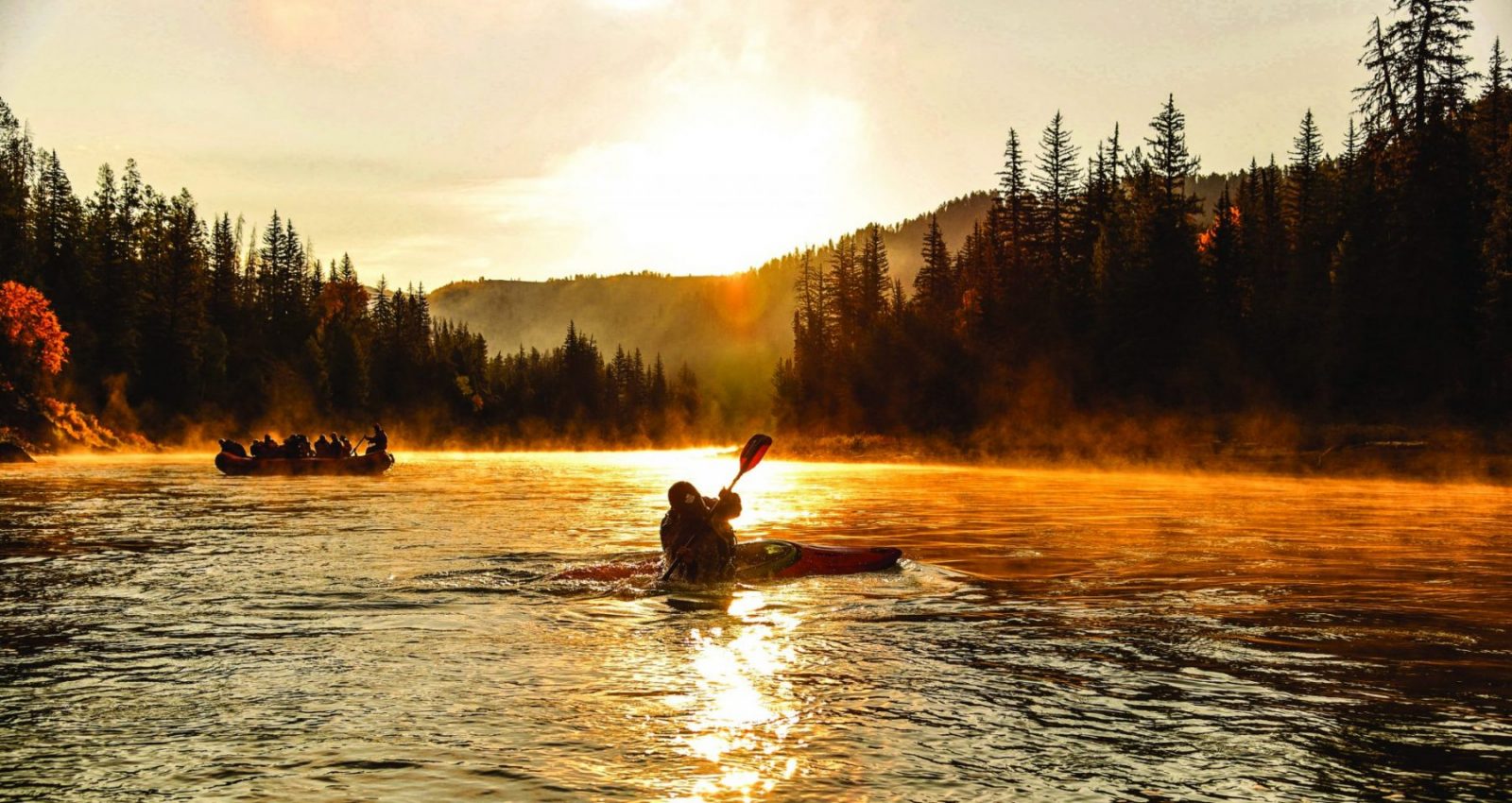
Ask most photographers about that “perfect” shot and they’ll tell you that while their craft involves skill, practice, and technique, there is also a certain amount of luck. So was the case for Kyle Aiton and the image he captured at dawn on the Snake River, which we featured in our 2018 calendar.
“I lucked out big time on that shot,” Aiton confessed. He was in his own kayak, trying to capture and set the tone from behind his lens. “I had been solely looking in the other direction, up-river and facing forward. But then I turned around and I saw the steam on the water. I saw the sun coming up. I just love that shot. Sometimes the scenery does all the work for you and you just have to press the shutter button.”
The image, although shot in color, shines with sepia tones in the fresh sunlight peeking over the mountain top. In the foreground, a kayaker deftly maneuvers his oar as water spills across his kayak. Further back, a group sits in a shadowed raft, and your eye is led down the glowing, tree-lined curve of the Snake as mist floats above the surface. It’s the kind of photograph that makes you instantly appreciate the beauty of this natural treasure and explains why people from across the globe come to fish, paddle, and just be in the presence of the mighty Snake River.
Aiton was on the water that morning as a photography instructor for Summit Workshops, a national organization that pairs students with mentors to hone their craft in stunning natural settings. It was the fourth day of a week-long adventure that had included trail running, rock climbing, kayaking, and fly fishing.
“We had arrived when it was still dark and cold,” he said. “Some people were nervous — they had never been on the water before. But soon you could sense everyone relax and get comfortable with just how amazingly beautiful it was.”
A full-time freelance photographer, Aiton had joined the workshop as a way to combine work, travel, and outdoor recreation. He grew up in North Carolina, and moved to Wyoming after college (the first time he’d been west of the Mississippi) to pursue an AmeriCorps position in Cheyenne building Habitat ReStores. He immediately fell for the West’s vast landscape, and for the past 10 years he’s split his time between Wyoming, Colorado, and Utah. But no place, he says, has ever left an impression on him like Wyoming has.
“The absolute solitude and drastic differences in landscapes you experience between Cheyenne and north towards Sheridan or west towards the Tetons” provide an indelible perspective, he said. Aiton discovered the many contrasts of Wyoming just as contrasts were happening in his own life. “Not only is Wyoming beautiful, I moved here at such a pivotal time in my life. It was a new chapter, and everything was new to me, so it was very impactful.”
It was in Wyoming that Aiton took up photography and began spending more time outdoors. He has a hand-me-down camera and started shooting his outdoor adventures with friends. Although his initial images weren’t his best technically, he was impressed with the content — people recreating and doing the things they love in dramatic landscapes.
He was honored to have his photograph selected for our 2018 calendar, and he said it made him feel proud to know he might be contributing to a greater cause just by “taking a beautiful picture of a beautiful place so that other people can appreciate it.”
The Snake River that Aiton captured flows south through Jackson Hole and cuts west between the Teton and Wyoming mountain ranges. It is renowned for its blue ribbon native trout fisheries — a vital resource in a landscape we have worked to protect over the past decade.
In 2013, after years of work with numerous partners, we celebrated the purchase and retirement of nearly 60,000 acres of oil and gas leases in the Upper Hoback Basin of the Wyoming Range. Our “Don’t Frack the Hoback” campaign ensured the headwaters of the Congressionally designated Wild and Scenic Hoback River — which flows into the Snake — would not be the location of 136 new oil and gas wells.
This year, an additional 24,000 acres of leases were retired from oil and gas drilling as part of the continuing work of citizens and local leaders who value the area’s vistas, outdoor recreation opportunities, and diverse wildlife.
Join Aiton and other photographers by submitting your own shot of Wyoming for the Outdoor Council’s 2019 Calendar Contest. You can enter your photos via Instagram or email. To submit your photo(s) via Instagram, you must have a public Instagram account so that we’re able to view your submission. Upload your photo(s) and add the hashtag #MyWyoming.
To submit your photo(s) via email, send your photo(s) to claire@wyomingoutdoorcouncil.org.
For more information about the contest, visit our Calendar Contest page.
[/et_pb_text][/et_pb_column][/et_pb_row][/et_pb_section]