There’s a lot to celebrate this week! The Wyoming Legislature has passed an excellent public lands resolution and a wonderful electric-vehicle bill, and the Game and Fish Department is getting much-needed tax relief.
BIG WIN FOR PUBLIC LANDS
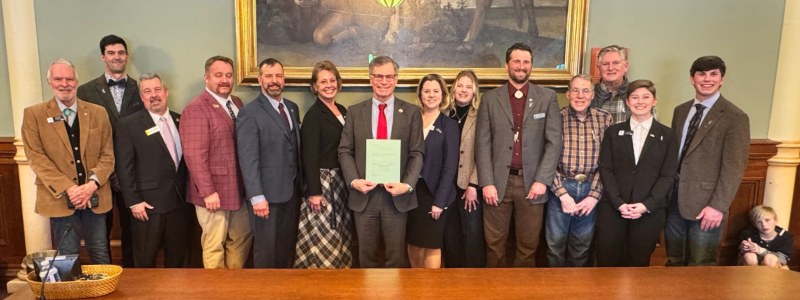
A resolution stating that Wyoming opposes the indiscriminate sale of public lands passed the House in a landslide and has been signed by Gov. Mark Gordon. While not legally binding, SJ9 is a huge win. It sends a clear message that public lands belong in public hands.
Thank you to everyone who contacted their lawmakers about this bill! It has been no small feat for the measure to get this far, and public support for the resolution played a major role in getting it passed.
GREAT NEWS FOR EV DRIVERS
Electric-vehicle drivers will no longer face triple taxation, thanks to a bill passed by the Legislature this week. HB145 eliminates sales tax on electricity sold at public charging stations, bringing it in line with gas stations, and removes red tape for smaller, low-speed charging stations. An amendment adopted this week also lowers the annual decal fee that EV owners pay from $200 to $100.
The bill now heads to the governor for his signature.
This legislation is a wonderful win for Wyoming! It makes the system fairer for Wyoming drivers, while ensuring that out-of-state EV drivers pay their fair share to maintain roadways. Thank you to everyone who helped get this bill passed.
GAME & FISH GETS A TAX BREAK
The Wyoming Game and Fish Department no longer has to pay property taxes on its office spaces, thanks to a bill passed in the Legislature this week. The move will save Game and Fish about $400,000 per year, at a time when costs are rising and revenue from hunting licenses is declining.
Game and Fish had been the only state agency paying property taxes on its offices. They will still owe taxes on other properties, such as herd management areas.
The bill has passed both houses of the Legislature and now goes to the governor for his signature.
Want to stay in the loop on important legislation and opportunities to take action? Sign up for email list!
It’s been another good week for conservation at the Wyoming Legislature! Here’s a recap of where we stand, and where we need your help.
PUBLIC LANDS RESOLUTION CLEARS SENATE
A resolution stating that Wyoming opposes the indiscriminate sale of public lands has passed the Senate! This is wonderful news — but the fight is not over. The bill is now being considered by the House, and we expect to see more opposition there.
We need your help to get this bill passed.Contact your representative today and tell them to vote YES on SJ9.
A bill that would right-size taxation for electric vehicles in Wyoming and reduce red tape for charging stations has passed the House and is being considered on the Senate floor. This is great news! HB145 would allow Wyoming EV drivers to pay just one annual fee — rather than three separate taxes — while ensuring that out-of-staters pay their fair share.
Help this bill get through the Senate! Contact your senator and tell them to vote YES on HB145.
Wyoming should be better equipped to fight wildfires this year, thanks to a funding package passed by both houses of the legislature. The legislation provides funding for 24 new wildland firefighting positions, outfits teams with important equipment, and offers more competitive retirement and paid leave plans, to boost recruitment and retention. The bills now head to the governor for his signature.
GAME & FISH COST-CUTTING MEASURE PROGRESSES
A bill that would save the Game and Fish Department hundreds of thousands of dollars has passed the Senate and is now being considered by the House. The bill would exempt Game and Fish from paying property taxes on its offices, saving the agency ~$500,000 per year and bringing it in line with other state agencies.
Want to stay in the loop on important legislation and opportunities to take action? Sign up for email list!
The momentum is continuing in Cheyenne! Despite one legislative setback, several good bills are moving forward. Here’s what you need to know from the past week.
PUBLIC LANDS BILL MOVES FORWARD
An excellent public lands resolution has cleared important legislative hurdles this week. SJ9, which states that Wyoming opposes the indiscriminate sale of public lands, passed unanimously in Committee and has now made it through two readings on the Senate floor. It will be heard once more in the Senate before going to the House.
While not legally binding, the resolution would send an important message that public lands are invaluable to Wyoming and should remain in public hands. Help get this bill to the next step by contacting your Senator today and telling them to vote YES on SJ9!
A bill that would right-size taxes for electric vehicle owners is moving forward.The current tax system subjects Wyoming EV drivers to triple taxation and is causing public charging stations to shut down. HB145 would make the system fairer for drivers and reduce red tape for charging stations — while still providing the state with revenue for road maintenance.
The bill passed the House Transportation Committee with full support — even WYDOT came out to speak in favor of it! — and has passed the first two readings on the House floor. It will be heard once more in the House before going to the Senate.
BACKYARD SOLAR DIES
Sadly, a bill that would have allowed Wyomingites to use “plug-in” solar panels has died. Plug-in solar, which is gaining popularity in other states, involves small panels that you plug directly into your home outlets. HB146 would have allowed Wyomingites to use this technology without going through a costly permitting process.
While the bill has died, lawmakers are planning to revisit the idea in the interim — i.e. after this year’s legislative session wraps up — so there’s a chance it could be back on the table in 2027.
TAX BREAK FOR GAME & FISH
The Game & Fish Department is the only state agency that pays property taxes on their offices. A proposed bill, which WOC is supporting, would exempt them from paying taxes on their headquarters and regional office buildings. This would save the agency approximately $500,000 per year, at a time when costs are rising. The bill has passed first reading in the Senate. It will be heard twice more before going to the House for consideration.
Several pieces of conservation-friendly legislation have been introduced in Cheyenne this week — thanks, in part, to your help! Here’s a rundown of what we’re watching.
PUBLIC LANDS: NOT FOR SALE?
A group of lawmakers from both the House and Senate are hoping to make one thing clear: Wyoming does not support the transfer or sale of public lands. Thirty-nine lawmakers, led by Sen. Eric Barlow of Gillette, have sponsored a resolution saying public lands are essential to Wyoming livelihoods and heritage and that they should remain in public hands. The Senate voted overwhelmingly to introduce the bill.
This is cause for celebration! The resolution would not carry legal weight, but it would be an incredible message to Wyomingites that local communities deserve a voice in how public lands are managed. If adopted, it would be sent to President Trump and Congress. It now heads to the Judiciary Committee.
BACKYARD SOLAR
Thanks to your help, lawmakers have introduced a bill that would give Wyoming residents a simple, affordable way to lower their electricity bills. HB146 would enable residents to use “plug-in” solar panels, which are small panels that you plug directly into your home outlet, without having to go through a costly permitting process. This is an exciting bill, and plug-in solar is a relatively new development in the solar industry that many states are starting to adopt to help residents address increasing electricity costs.
The bill will be heard by the House Transportation Committee on Tuesday, Feb. 17 at noon, and we need your help supporting it!
To testify in person: Simply show up to the Capitol on Feb. 17.
To testify on Zoom: 1. Visit the “Legislative meetings” page on Monday, Feb. 16* 2. Find the House Transportation Committee. 3. Click the “testify” button.
* You can’t sign up until Feb. 16…
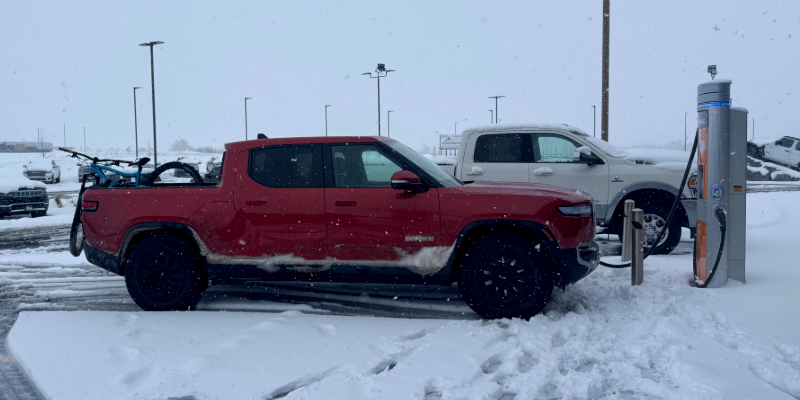
An electric vehicle charging station in Wyoming. (Photo: Dave Leon)
RIGHT-SIZING ELECTRIC VEHICLE TAXATION
Electric vehicle drivers in Wyoming currently pay three overlapping taxes: an annual EV decal, an Alternative Fuel Tax, and sales tax on electricity. This triple taxation is not only unfair to drivers — it’s causing public charging stations to go offline, due to the administrative burden.
Lawmakers are considering a bill that would allow residents to pay only one up-front fee, and would exempt smaller, low-speed charging stations (like hotels or senior centers) from licensing and tax requirements. HB 145 would shift the tax burden to high-speed chargers, which function more like gas stations. This bill benefits Wyoming residents and businesses, while ensuring that out-of-state EV drivers pay their fair share. It will be heard in the House Transportation Committee on Feb. 17.
ENHANCING WILDLAND FIREFIGHTING
A series of bills that would enhance Wyoming’s firefighting capacity have passed first reading on the House floor. HB0034 and HB0035 would give wildland firefighters more competitive retirement and paid leave plans, which is expected to increase recruitment and retention. And HB0036 and HB0037 would add more staff to the State Forester’s office, increasing capacity for fuels projects and wildfire response.
NUCLEAR WASTE: NO CONSTITUTIONAL AMENDMENT
A closely watched proposal that would have given voters the chance to decide whether nuclear waste should be stored in Wyoming has died. The measure called for a constitutional amendment requiring a public vote any time there’s a request to store spent nuclear fuel or high-level radioactive waste in Wyoming. Although this resolution failed introduction in the House 32:30, WOC supports the idea of consent-based siting.
ONE DAY LAST SUMMER, I ran into an acquaintance in Laramie. It was June, and the battle around selling off public lands was at its peak. I encouraged my friend to call her senators and tell them to vote no.
She sighed.
“What good will it do?” she asked. “They’re not going to listen to me.”
I was stunned. This was a woman who had always struck me as politically engaged. If she wasn’t speaking up, who would?
My friend’s skepticism is not uncommon. Many Wyomingites are reluctant to contact their lawmakers, because they assume it won’t make a difference. But how true is that? Is there value in engaging politically, when it seems like a losing battle? How much difference can a small group of citizens make?
“People have a tremendous opportunity to influence legislation,” says Ryan Williamson, a political scientist at the University of Wyoming who specializes in American government and politics. “Legislators want to keep their job. They want to win reelection.” So they pay attention to what their constituents are saying.
Even if you are in the minority, you can make a difference, Williamson says. That’s because most people don’t speak up at all.
“Your average American, their idea of political engagement is maybe voting every four years,” Williamson says. “The high-performing American also votes in midterm elections. … But as far as direct contact with legislators, that is a very small subset.”
As a result, those who do reach out can have an outsized influence.
This is especially true in Wyoming, where each state lawmaker only represents a few thousand people. If they receive 50 calls about a certain issue, that’s a meaningful percentage of their constituency and could make or break legislation — especially on lesser-known issues, where a lawmaker’s mind isn’t entirely made up.
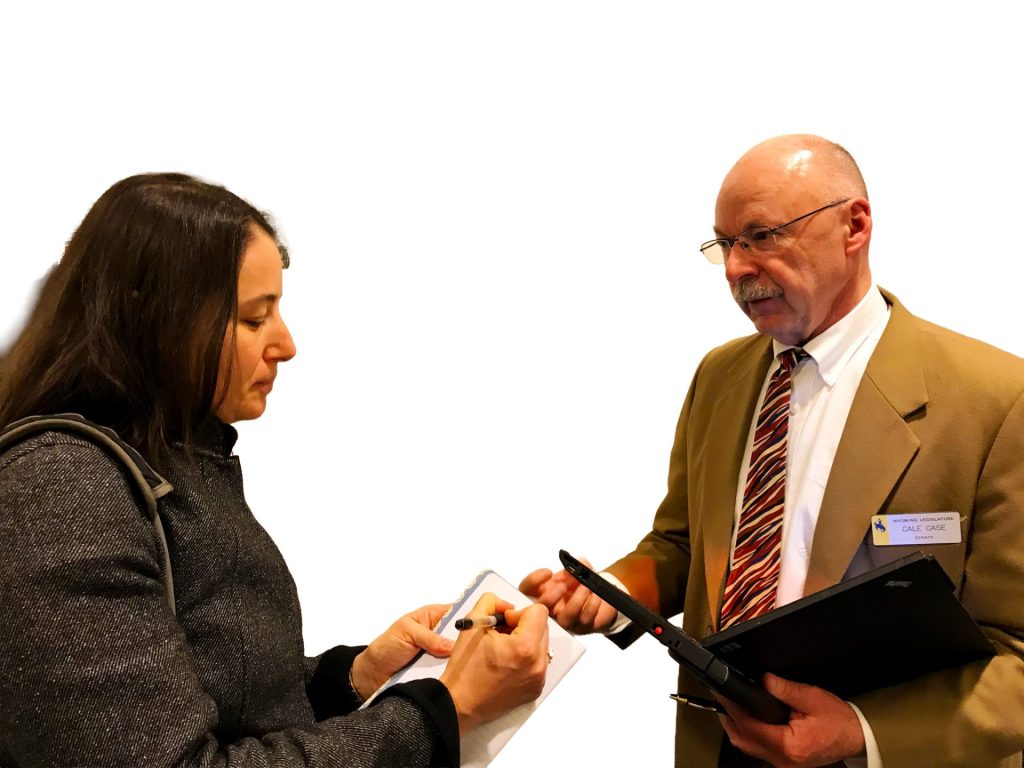
Era Aranow, a former WOC intern and staffer, speaks to Sen. Cale Case at the Capitol. (Photo: WOC staff)
This scenario is not just theoretical; we’ve seen it play out in Wyoming multiple times.
One of the most recent examples was during last year’s legislative session. John Burrows, WOC’s Energy and Climate Policy Director, remembers the day vividly.
It was Jan. 29, 2025, and John had gone to Cheyenne to testify before the House Minerals, Business, and Economic Development Committee. The committee was discussing a bill that would allow Wyoming to become the dumping ground for the nation’s nuclear waste.
John felt an anxious weight in his stomach as he walked up the snowy steps to the Capitol. He knew the best chance to stop this bill would be now. If the bill made it over to the senate and passed into law, Wyoming would be liable to feel the consequences for thousands of years.
The committee room filled with people who came to testify. Others joined online. Everyone had questions.
The meeting went on for an hour, then two. And then, one lawmaker made a comment that John knew would be pivotal. It was Rep. Mike Schmid of La Barge who spoke. “I’ve got hundreds of emails,” he said. “And not one is in support of … this idea.”
John’s pulse quickened. Hundreds of emails, he thought. And not one in support. Surely, lawmakers couldn’t ignore that level of public opposition.
Sure enough, the bill died that day in committee. Lawmakers couldn’t justify supporting a measure that their constituents so vehemently opposed.
A tiny win now could pave the way for a bigger victory down the road.
To John, this is a classic example of Wyoming’s small government at work.
“It doesn’t take as many citizens reaching out to have an impact as you might imagine,” he says. “A hundred or 150 people sending an email … can absolutely stop bad legislation from moving forward.”
This has happened on multiple issues over the years. In 2016, public outcry killed a bill that would have called for federal lands to be transferred to the state. In 2024, public pressure prompted the Wyoming legislature to agree to sell the Kelly Parcel to Grand Teton National Park. And year after year, legislation aimed at dismantling net metering — which allows rooftop solar customers to be compensated for the excess energy they feed back into the grid — fails because of steadfast opposition from citizens.
“Everybody’s coming out with a pitchfork saying, ‘No, don’t do this,’” John says. “And so that’s what keeps winning the argument around net metering.”
You won’t win everything. There are certain issues where lawmakers’ opinions are so entrenched that no amount of public input is going to make a difference. But even if you don’t win outright, there can be hidden benefits.
For one thing, speaking up publicly can raise awareness around an issue. It can help with fundraising efforts for the cause. It can even pave the way for recruiting new candidates for the next election cycle.
Secondly, politics is not a zero-sum game. Sometimes it’s not about passing a good bill, or killing a bad one, but rather about modifying legislation to make it more palatable. Baby steps count.
“Your average American kind of expects change to happen suddenly and substantially,” says Ryan Williamson, the political scientist we heard from earlier. “But especially if you’re in the minority, change is going to come, at best, incrementally.” A tiny win now could pave the way for a bigger victory down the road.
Finally, even if you don’t change a politician’s mind, you are still holding them accountable when you speak up.
“Even if one person reaches out … then that legislator can no longer say, ‘No one is opposed to this,’” Williamson says. You might plant a seed of doubt in their mind, and that seed could grow over the years as more people start championing the issue.
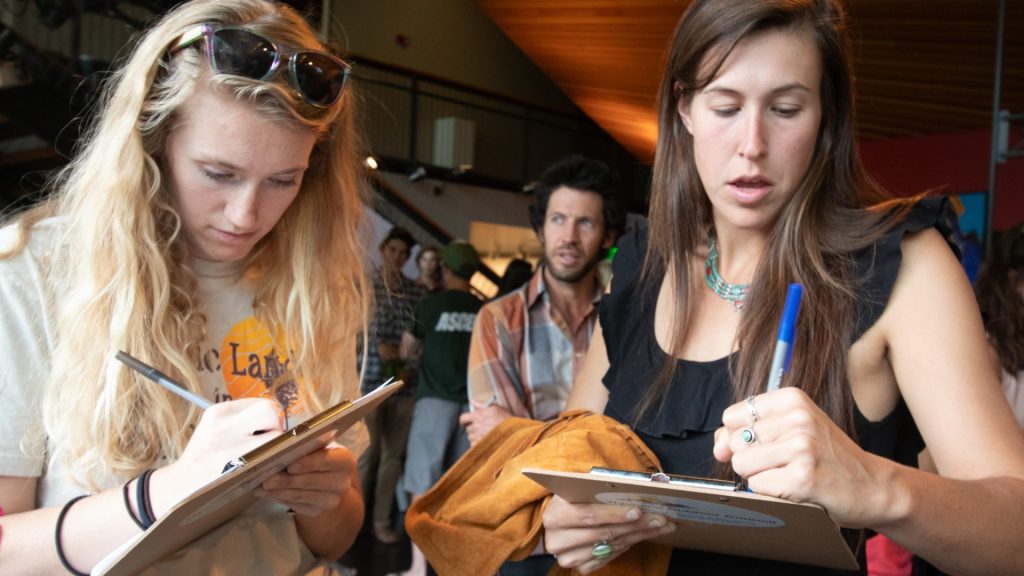
Constituents write to their lawmakers at a rally in Jackson. (Photo: Claire Cella)
At the end of the day, Williamson says, you have to ask yourself if you are content with the status quo.
“If you care enough, you just have to trust that your contribution, at some point, in some way, will be meaningful,” he says. “Not to do anything would be a kind of implicit endorsement of the status quo.”
That is the mindset that Pinedale resident JJ Huntley lives by. JJ calls her lawmakers at least once a month, and sometimes more often. She focuses mostly on Wyoming’s congressional delegation — the people representing her in Washington — and she reaches out about a range of issues, from public land sales to federal layoffs to immigration.
This outreach has never — not once — made a tangible difference. Her lawmakers have never voted the way she wanted on these issues. But JJ is unwavering in her commitment to keep trying.
Part of it is personal: The process of articulating her position reaffirms her values. It reminds her of everything she loves about Wyoming. Partly, she wants to set an example for the next generation. And partly, it comes down to the belief that if she says nothing, she will be complicit in bad policymaking.
“If we aren’t talking, then we’re basically saying we don’t care,” JJ says. “There will not be a change. … I want my voice to matter, so I have to keep talking until it does.”
“If you care enough, you just have to trust that your contribution, at some point, in some way, will be meaningful.”
— Ryan Williamson
I recently attended a film screening in Laramie hosted by a Wyoming nonprofit. After the movie, the attendees sat around in a circle and talked about our hopes for the future. The executive director urged us to be vocal during the legislative session.
There was silence for a moment, and then one woman raised her hand.
“How much good will it actually do to contact my lawmakers about this?” she asked.
I nearly leapt out of my seat. “I can answer that!” I said eagerly.
I proceeded to tell her everything I had learned researching this story: how a small but vocal minority can influence legislation, especially in a state like Wyoming; how political engagement often has hidden benefits, even if you don’t win outright; how tiny victories add up.
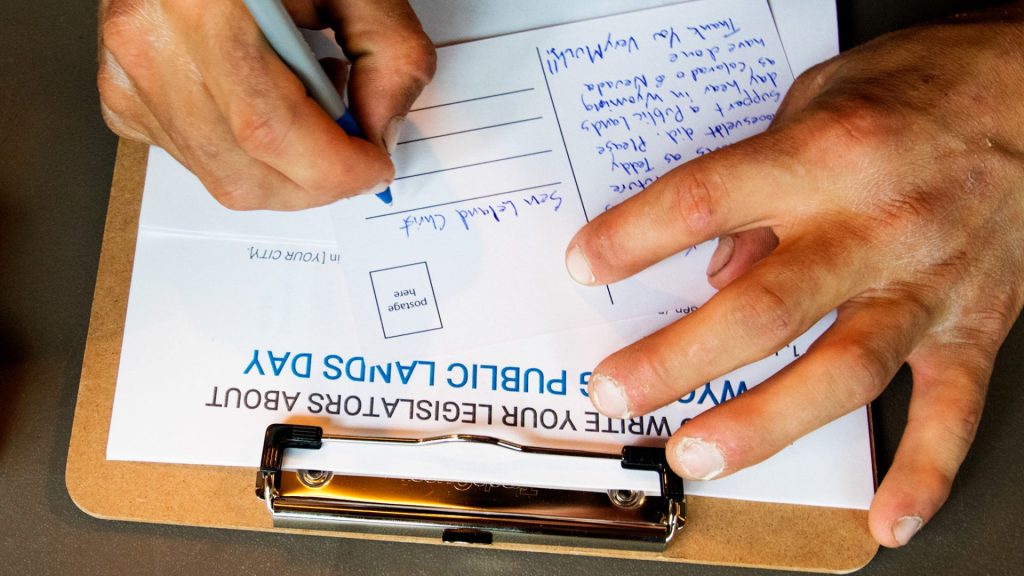
A constituent writes to a legislator in defense of public lands. (Photo: Claire Cella)
We can’t know how — or if — our input will make a difference. But one thing is sure: If we don’t engage, we won’t be making a difference.
As Ryan Williamson put it, “Politics is hard. Change is slow. And it’s easy to get disenchanted. But the health of a democracy is dependent on engagement from the citizenry.”
If you’re on the fence about speaking up, he says, ask yourself this: “How would you feel knowing that you could have done something?”